In-Situ and Precast Concrete Processes and Uses
Concrete is one of the most widely used materials in construction, but it is not always produced and placed in the same way. Depending on the project, concrete may be mixed and poured directly at the construction site, or it may be manufactured somewhere else and transported to the site for installation. Understanding the in-situ and precast concrete processes and uses can help beginners understand why different construction projects use different methods.
Imagine building with concrete as preparing a meal. With in-situ concrete, the ingredients are brought to the kitchen, prepared, cooked, and served in the same place. With precast concrete, some of the preparation and cooking happens somewhere else before the finished product is delivered to the site. Both methods can produce strong and durable structures, but they have different advantages, limitations, and applications.
For anyone learning construction, understanding these two approaches is important because the choice between them can affect construction speed, quality control, labour requirements, cost, and the overall appearance of a building. This article explains how both processes work, where they are commonly used, and how to know which approach may be more suitable for a project.
What Are In-Situ and Precast Concrete?
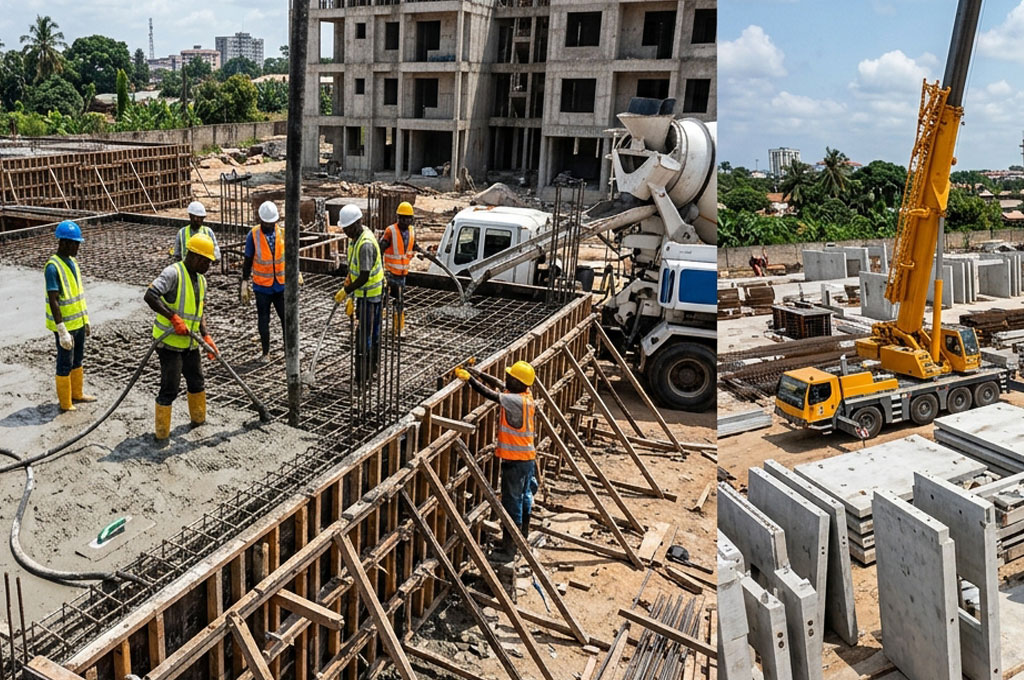
In-situ concrete, sometimes called cast-in-place concrete, is concrete that is mixed, placed, and allowed to harden at its final location within the structure. For example, when workers prepare reinforcement and formwork for a building column and then pour concrete directly into the column mould, they are using an in-situ construction method. The concrete becomes part of the structure exactly where it was poured.
Precast concrete follows a different approach. Concrete components are manufactured in a controlled location, usually a precast factory or casting yard, and allowed to gain sufficient strength before they are transported to the construction site. Items such as concrete beams, columns, wall panels, stairs, drainage channels, and floor units can be produced in this way and later installed as parts of a larger structure.
The major difference is therefore the location where the concrete element is formed. In-situ concrete is produced or placed at its final position, while precast concrete is produced away from its final position and transported there. Neither method is automatically better in every situation. The appropriate choice depends on the size of the project, available equipment, design requirements, site conditions, construction schedule, and budget.
The In-Situ Concrete Process
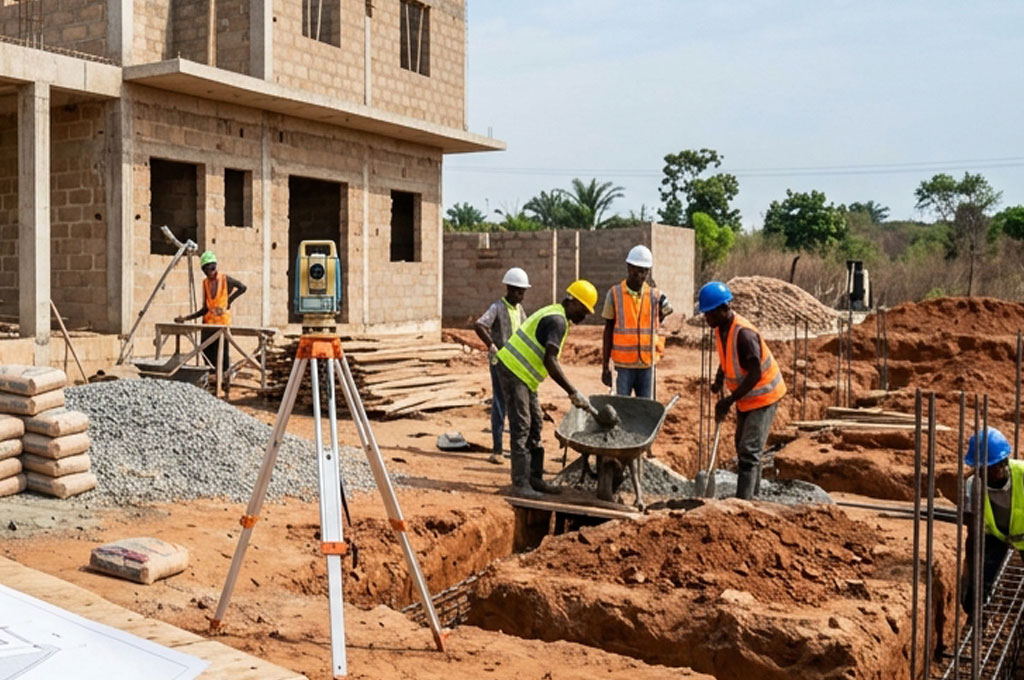
The in-situ concrete process normally begins with preparing the location where the concrete will be placed. Depending on the structural element, this may involve excavation, ground preparation, reinforcement installation, and the construction of formwork. Formwork acts like a temporary mould that holds fresh concrete in the required shape until it becomes strong enough to support itself.
After the reinforcement and formwork have been properly positioned, the concrete is mixed and transported to the required location. The fresh concrete is then placed into the formwork. Workers must ensure that the concrete fills the space properly and surrounds the reinforcement without leaving large air pockets. Mechanical vibration is often used to help compact the concrete and improve its density.
The final stage is curing. Fresh concrete does not reach its required strength immediately after pouring. It needs appropriate moisture and temperature conditions while it gains strength. Proper curing is particularly important because poor curing can contribute to cracking, reduced strength, and durability problems. This is one reason why careful site supervision is essential when using in-situ concrete.
The Precast Concrete Process
The precast concrete process begins away from the final construction location. A mould is prepared according to the required dimensions of the concrete component, and reinforcement is positioned inside it where necessary. Concrete is then placed into the mould and compacted. Because the work is carried out in a controlled environment, manufacturers can closely monitor the materials, moulds, mixing process, and curing conditions.
Once the concrete has gained enough strength, the component is removed from the mould and prepared for transportation. Depending on its size and weight, special trucks, lifting equipment, and cranes may be required. Planning is important because a precast component must be transported safely and installed accurately at the construction site.
At the site, the finished component is lifted or positioned into its intended location and connected to other structural elements. For example, a precast staircase can be manufactured before the building reaches the stage where the staircase is needed. Once the supporting structure is ready, the staircase can be transported to the site and installed rather than being constructed from fresh concrete on location.
Uses of In-Situ Concrete in Construction
In-situ concrete is commonly used where the structure needs to be formed directly on the construction site. Building foundations are a major example. Footings, ground beams, foundation slabs, retaining structures, columns, beams, and suspended slabs may all be constructed using in-situ concrete depending on the design.
Another advantage is flexibility. Construction sites do not always have identical conditions, and some structural elements may require dimensions or shapes that are difficult to manufacture and transport as precast components. With in-situ construction, formwork can often be adjusted to suit the actual site conditions and structural requirements.
In-situ concrete is also useful for projects where transporting large components would be difficult or expensive. A building located on a restricted site, for example, may not have enough space for large delivery vehicles or cranes. In such situations, producing and placing concrete at the site can be a practical solution.
Uses of Precast Concrete in Construction
Precast concrete is widely used when construction teams want to manufacture repeated components efficiently. Residential and commercial developments may use precast floor units, stairs, wall panels, beams, columns, boundary elements, and other components. Infrastructure projects also use precast products for drainage systems, culverts, kerbs, barriers, pipes, and similar applications.
One of the strongest advantages of precast construction is repetition. If a project requires dozens of identical components, manufacturing them under controlled conditions can make the work faster and more consistent. Instead of constructing every component separately on site, many units can be produced in advance while other activities continue.
Precast concrete can also reduce the amount of work required at the construction site. Once the components arrive and the necessary supports are ready, installation can be relatively quick. This can be especially useful on projects where reducing construction time is a major priority. However, transportation, lifting equipment, storage space, and accurate installation must all be considered during planning.
In-Situ and Precast Concrete Processes and Uses Compared
The choice between in-situ and precast concrete often comes down to balancing flexibility against speed and controlled production. In-situ construction provides considerable freedom to adapt the concrete work to the conditions of the site. Precast construction, on the other hand, moves much of the production work away from the site and can make repeated construction faster.
Quality control can also work differently between the two approaches. Precast components are generally manufactured under controlled conditions, which can make it easier to monitor production and curing. In-situ concrete can also achieve excellent quality, but the result depends heavily on site conditions, material handling, placement, compaction, curing, and supervision.
Cost should not be judged simply by comparing the price of fresh concrete with the price of a precast component. A proper comparison should consider labour, formwork, transportation, cranes, equipment, storage, construction time, wastage, and the complexity of the project. A method that appears cheaper at one stage may become more expensive when all associated costs are included.
Choosing Between In-Situ and Precast Concrete
For a project with unusual shapes, difficult access, or limited transportation options, in-situ concrete may be more practical. It allows the construction team to form the concrete directly where it is needed. This can be particularly useful for foundations and structural elements that are closely connected to the actual ground conditions.
Precast concrete may be more attractive when a project contains many repeated components and has suitable access for transportation and lifting. A large development with numerous identical wall panels or stairs, for example, can benefit from manufacturing those elements in advance. The faster installation can also help different construction activities progress more efficiently.
The best decision should therefore be made during the design and planning stage rather than after construction has already started. Engineers, architects, contractors, and project managers need to consider the structural design, site conditions, available labour, equipment, transportation routes, construction programme, and total project cost before selecting the method.
Advantages and Limitations of Both Methods
In-situ concrete offers flexibility and is particularly useful when construction must respond to actual site conditions. It can be used for structures of many different shapes and sizes, and it does not require every component to be transported from another location. This makes it a practical choice for many foundations and building structures.
However, in-situ construction can be affected by weather, site organisation, labour availability, and the quality of workmanship. Formwork may also require significant time and labour, particularly when a project contains many repeated concrete elements. Delays in one part of the concrete operation can sometimes affect several other construction activities.
Precast concrete can provide speed, consistency, and controlled production. Components can be manufactured while other site activities are taking place, potentially reducing the time required for final installation. Its limitations include transportation requirements, lifting equipment, storage needs, and the need for accurate planning. Very large or unusually shaped components may also be difficult to transport economically.
Why Understanding These Concrete Methods Matters
For beginners entering the construction industry, understanding these methods provides a useful foundation for making better decisions on site. Concrete may look like a simple mixture of cement, aggregates, and water, but the way it is produced, placed, cured, transported, and installed can have a major effect on the finished structure.
The in-situ and precast concrete processes and uses also show why construction is about more than simply selecting materials. A material must be considered together with the method used to place it. A technically suitable concrete component may not be practical if the site cannot accommodate its transportation or installation.
Whether a project uses in-situ concrete, precast concrete, or a combination of both, good planning and supervision remain essential. Understanding the strengths and limitations of each approach helps construction professionals choose methods that are safe, practical, durable, and appropriate for the project.
Conclusion
The in-situ and precast concrete processes and uses represent two important approaches to modern construction. In-situ concrete is formed and hardened at its final location, giving construction teams flexibility and allowing them to respond directly to site conditions. Precast concrete is manufactured away from the final location and transported to the site, offering the potential for controlled production, repetition, and faster installation.
Neither method should be considered universally superior. The right choice depends on the project requirements, site access, structural design, available equipment, labour, transportation, schedule, and total cost. In many real construction projects, both methods can even be combined to achieve a practical balance between flexibility and efficiency.
If you are learning construction or planning a building project, take time to understand how concrete will be produced, placed, cured, transported, and installed before work begins. A better understanding of these processes can help you communicate more effectively with engineers and contractors and make more informed construction decisions. If you found this guide useful, share it with someone learning construction and explore more articles on concrete, building methods, and house construction.